
 Illustrative image
Buy scaffolding tubes
Live stock from our inventory management system: 0 scaffolding parts in scaffolding tubes in stock – second-hand and inspected, up to 70% cheaper than new stock. Green = available immediately from stock, orange = available on request.
Parts order
Used parts from stocknur Lagerware · sofort lieferbar›
New parts from the CETRAC catalogueSPEED available to order now · MGS, MODUX from 2027 · DIBt approval applied for›
Order scaffolding parts – enter quantities, done
- 1 Select parts
- 2 Check preview
- 3 Send request
Illustrative image
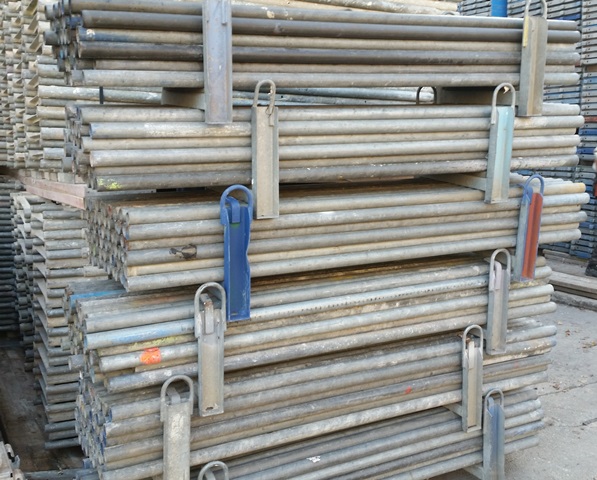
Scaffolding tubes form the flexible basis of the tube-and-coupler scaffolding system and enable stable, adaptable structures in almost any configuration. They combine load-bearing, bracing and connection functions in a single component and are ideal for specialised scaffolding, suspension systems and complex structures.
Scaffolding tubes – The basics
Scaffolding tubes are the basic component in traditional tube-and-coupler scaffolding and are also used in many modular scaffolding systems as supplementary or specialised components.
Among other things, they serve as:
- Support and connecting element (vertical, horizontal, diagonal brace)
- Basic structure for special designs, suspensions and bracing
- Connecting component for couplers, netting, tarpaulins, brackets and temporary structures
Without scaffolding tubes, there can be no flexible pipe coupling system – they form the ‘lines’ in the three-dimensional scaffolding grid.
To connect them, you’ll need the right couplers: swivel and fixed scaffolding clamps.
Typical uses of scaffolding tubes
Scaffolding tubes are used wherever maximum flexibility is required:
- Construction of pipe coupling frameworks in all geometries
- Supplementing system scaffolding for bespoke solutions
- Suspensions and cantilevers on steel structures, concrete or existing structures
- Bracing and additional supports for increased structural requirements
- Support structures such as beam trusses, cross-beams and material platforms (always in accordance with structural analysis)
- Anchorage points for safety nets, tarpaulins, enclosures or roof structures
The combination of scaffolding tubes and couplers forms a ‘modular system’ capable of replicating almost any geometry – provided it is properly planned and assembled.
An overview of all scaffolding tubes
Standard scaffolding tubes
Standard tubes for load-bearing, connecting and bracing applications in scaffolding.
- Used as a standard strut, ledger, diagonal brace or special component
- suitable for coupling connections
Short pipes / connecting pipes
Short lengths of pipe for creating connection points.
- e.g. for couplers, brackets, anchor points or temporary fixings
Bracing and diagonal tubes
Tubes used primarily for diagonal braces or stiffeners.
- form stable structures in both the longitudinal and transverse directions
Pipe extensions / connecting pipes
Pipes or pipe sections used to adjust the length or to extend the pipe.
- e.g. in special designs or when adapting to building edges
Specialised pipes (e.g. for suspensions, bridging)
Pipes designed specifically for particular applications.
- Suspensions from steel girders
- Temporary structures, transitions, temporary supports
Scaffolding tubes: Pros and cons
All scaffolding tubes are available for immediate delivery:
Calculate scaffolding area
Are you putting your scaffolding together from individual parts? With our EasyFlow scaffolding area calculator, you can first work out the scaffolding area you need – so you’ll know exactly how many scaffolding tubes and other components you’ll require. It’s free, with no obligation, and takes just a few seconds.
FAQ – Scaffolding tubes
For load-bearing, connecting and bracing applications – particularly in pipe coupling systems and special structures.
Standard scaffolding tubes can often be used across different systems when connecting tubes; however, system approvals and standards must always be observed.
Flexibility: Irregular shapes, suspensions, transitions and special designs can often only be effectively achieved using pipes and couplers.
Generally speaking, yes. Scaffolding tubes are connected to one another using couplers or the system’s own connection technology.
They require experienced staff, as the planning and installation are more complex than with a simple plug-in or frame system.
Yes, but only within the limits of the relevant system approvals and structural specifications. Mixed-construction methods must be planned by qualified professionals.
The effort involved in planning and installation is greater, but so are the benefits in complex projects – thanks to flexibility and reusability.