
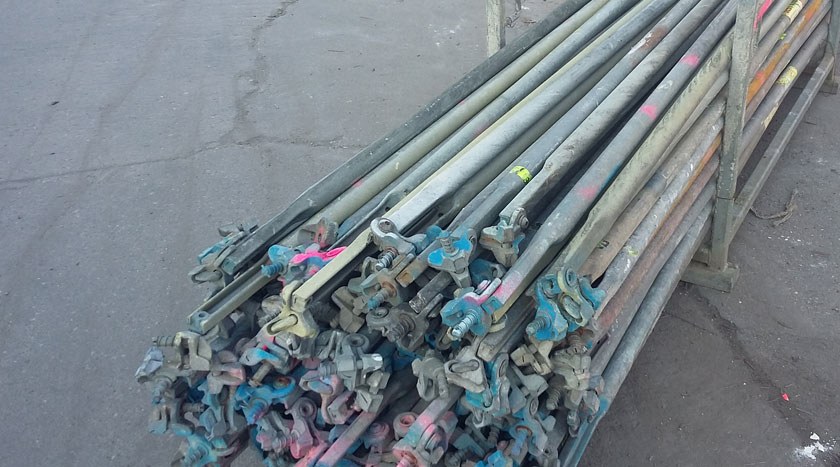
Buy scaffolding diagonal braces
Live-Bestand aus unserer Warenwirtschaft: 19 Gerüstteile in Diagonalen auf Lager – gebraucht und geprüft, aktueller Preis im Angebot. grün = sofort ab Lager, orange = auf Anfrage lieferbar.
Parts order
Used parts from stockstock items only · available immediately›
New parts from the CETRAC catalogueSPEED available to order now · MGS, MODUX from 2027 · DIBt approval procedure not yet completed›
Order scaffolding parts – enter quantities, done
- 1 Select parts
- 2 Check preview
- 3 Send request
Diagonals are essential components for the vertical bracing of scaffolds and make a decisive contribution to the stability of the entire structure. Their length varies depending on the scaffold bay, adapting to the specific requirements. The type of fastening depends on the scaffold type: while Layher frame scaffolds often use diagonals with a wedge head coupler, modular scaffolds use other fastening systems. Thanks to their precise fit and robust connection, diagonals ensure a high level of safety and load-bearing capacity, even under difficult conditions.
Diagonal braces and their applications
- Bracing of façade, working, assembly and modular scaffolding
- Protection against wind loads and lateral forces
- Stabilisation of individual scaffolding bays or entire sections of scaffolding
- Essential for high scaffolding classes and for wide and tall structures
- For use in new-build projects, refurbishment, façade work or industrial installation projects
- Ensuring the scaffolding geometry on uneven ground
Variants & System Allocation
The CETRAC range comprises diagonal braces in various designs, tailored to:
- various field lengths and field heights
- different scaffolding systems
- Steel and aluminium structures
The selection is always made on a system-by-system basis – to suit the specific design and area of application.
Diagonal braces and their properties
Diagonal braces: Cost, Compatibility and Benefits
CETRAC stocks all diagonal braces at the best price
Please contact us if you have any questions about manufacturers, condition or specific requirements.
A wide selection of diagonal braces, both second-hand and new
Price examples for scaffolding diagonal braces in the CETRAC range:
*All prices as at 04/2026, excluding VAT and delivery charges / Prices may vary
1 Submit an enquiry →
2. Quote within 24 hours →
3 Picking & Dispatch
Calculate scaffolding area
Are you putting your scaffolding together from individual parts? With our EasyFlow scaffolding area calculator, you can first work out the scaffolding area you need – so you’ll know exactly how many diagonal braces and other components you’ll require. It’s free, with no obligation, and takes just a few seconds.
FAQ – Diagonal brace
They brace the scaffolding laterally and secure it against wind loads and horizontal forces. In this way, they ensure the scaffolding remains stable and prevent it from shifting or toppling over.
Yes. In almost all assembly configurations, diagonal braces are required to ensure stability and are specified by the applicable safety requirements and standards for scaffolding.
The number varies depending on the system and is determined by the assembly height, width, load class and the manufacturer’s specifications. The relevant scaffolding system and its compatibility, as well as the applicable assembly requirements, are decisive in this regard.
Yes – depending on the bay length and the system. The correct length depends on the scaffolding frame used and the specific bay dimensions.
- Incorrect bay selected
- Not fitted in accordance with the system specifications
- Incomplete bracing across several storeys
Such mistakes can be avoided by following the professional assembly instructions.
Yes – without effective diagonal braces, scaffolding is not stable. Together with the horizontal braces, the diagonal braces form the scaffolding’s load-bearing framework.