Buying Scaffolding for Renovation & Old Building Refurbishment - What Really Works
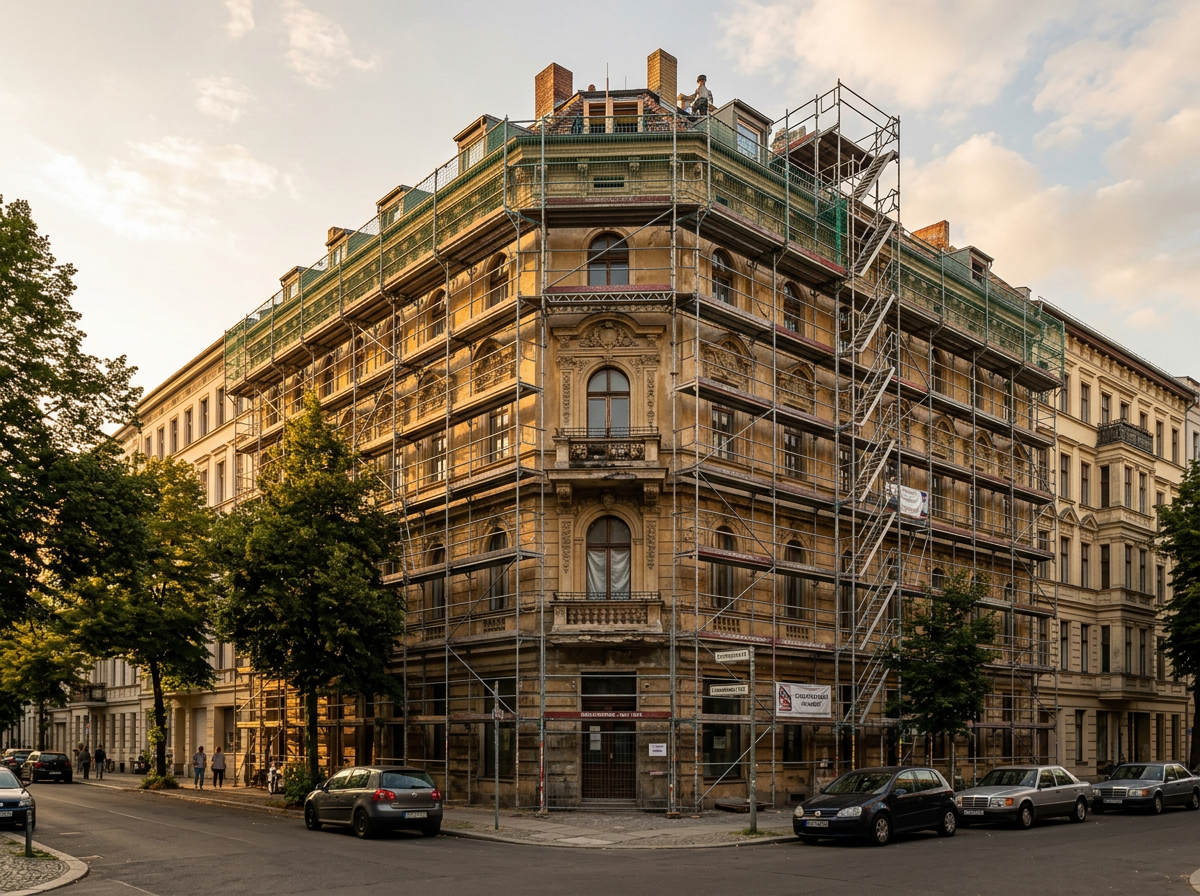
Old buildings are the heart of many European cities - and at the same time the biggest challenge for anyone wanting to erect scaffolding. Uneven facades, narrow courtyards, historic fabric and changing work areas make scaffold planning for renovation projects far more demanding than on a greenfield site. If you want to buy scaffolding for an old building renovation, you don't need a universal scaffold - you need the right system for the specific job.
This guide explains which scaffold types really work on typical old-building renovations, what to look out for with uneven ground and confined spaces - and how to save real money along the way.
Why old-building renovations place special demands on scaffolding
A new build offers a level base, free access and uniform facade surfaces. The old building is the exact opposite: uneven render, projecting cornices, old bay windows, mansard roofs and often narrow access routes or courtyards define the picture. This creates three core problems for scaffolding:
1. Uneven surfaces & varying distances
Old-building walls are rarely plumb. Cornices, stucco elements or retrofitted attachments force the scaffold to stand at varying distances from the wall. Rigid frame systems quickly reach their limits here.
2. Narrow courtyards and limited standing areas
Many Wilhelminian-era buildings have courtyards of 4 to 8 metres in width. A classic facade scaffold with standard bay lengths simply doesn't fit - or blocks escape routes and access ways.
3. Several trades, one scaffold
Old-building renovations rarely run on a tidy schedule. Plasterers, window fitters and painters often work on the same scaffold one after another. The system must be flexible enough to be reconfigured without dismantling and re-erecting it every time.
Which scaffold for which old-building task?
Facade scaffold - the classic for linear outer walls
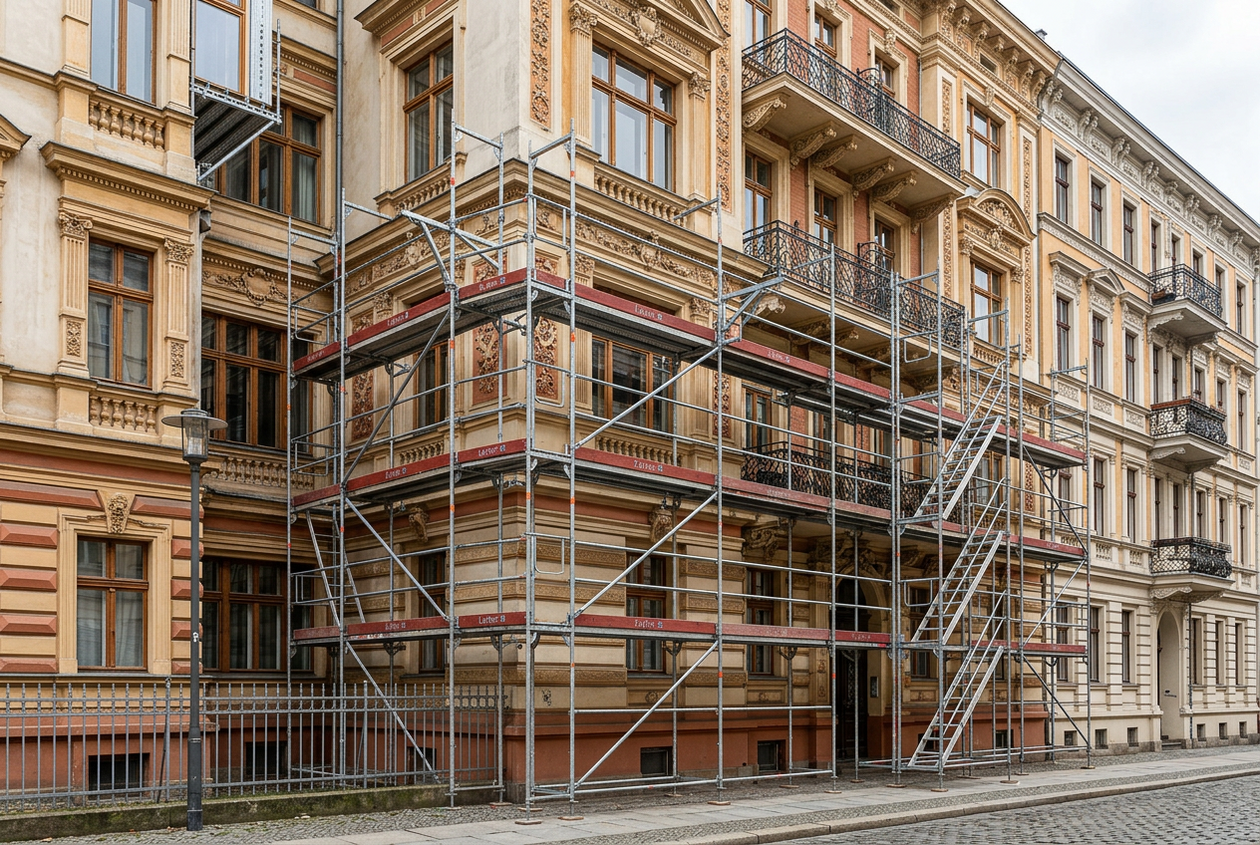
The facade scaffold is the first choice for old-building renovations when the outer wall runs reasonably straight and there is enough space in front of the building. It provides even working surfaces over the full building height, is quick to erect and dismantle, and is readily available in the common system families (Layher Allround, Hünnebeck Bosta, Peri Up).
Special considerations on old buildings:
- Choose base jacks with enough extension to compensate for uneven ground (rule of thumb: ±30 cm adjustment per leg)
- Plan bracket extensions for projecting cornices or bay windows - keeping the main structure stable
- Deck width of at least 0.60 m, better 0.73 m, for working with tools and material at the same time
Typical applications: Rendering (external render, ETICS installation), facade painting, window replacement
Modular scaffold - the flexible solution for complex old-building geometries
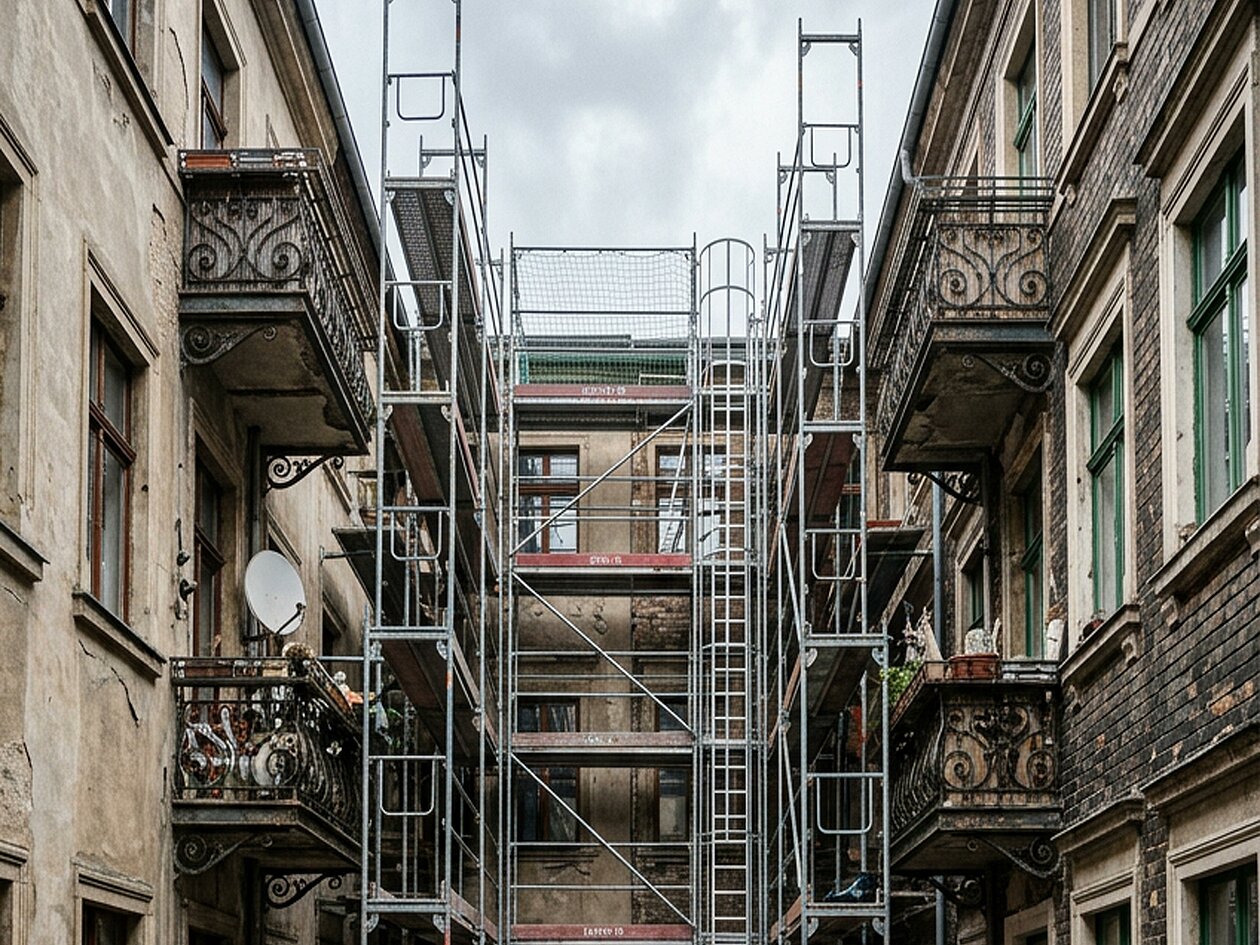
Where the facade scaffold reaches its limits due to rigid bay lengths, the modular scaffold plays to its strengths. The free grid of its node points means it can be adapted almost arbitrarily in plan and height - ideal for corner situations, courtyards, avant-corps and buildings with alternating recesses.
Special considerations on old buildings:
- Adapts to almost any floor plan thanks to variable bay lengths (0.50 m to 3.00 m)
- Courtyards less than 6 m wide can be accessed with special configurations
- Allow extra planning time - the flexibility costs a little more time on first assembly
Typical applications: Courtyard developments, corner buildings, old industrial buildings, buildings with annexes
Rolling scaffold / mobile scaffold - the quick solution for interior work
If you're working inside an old building - for example on ceiling refurbishment, replacing interior windows or restoring stucco - a mobile aluminium scaffold usually gets you there fastest. It can be repositioned in minutes and needs no fixed foundation.
Special considerations on old buildings:
- Room heights of 3.50 m to 5.00 m are typical for Wilhelminian and Art Nouveau buildings - choose the scaffold height accordingly
- Swivel castors with locking brakes are mandatory on old wooden floors
- The light weight (aluminium) protects delicate historic floors
Typical renovation jobs and the right scaffold at a glance
| Job | Recommended system | Special note |
|---|---|---|
| External render / ETICS | Facade scaffold | Bracket extensions for cornices |
| Facade painting | Facade scaffold | Plan protective netting against splashes |
| Window replacement | Facade scaffold | Keep individual bays removable |
| Roof work (eaves) | Roofing scaffold | Note catch roof / toe board |
| Narrow courtyard | Modular scaffold | Special bay lengths 0.50 - 1.50 m |
| Corner building / L-shape | Modular scaffold | 3D planning recommended |
| Interior renovation / stucco | Rolling scaffold (aluminium) | Height adjustment without reconfiguration |
Buy or hire? What pays off on an old-building project
For owners with several renovation phases, trade businesses or property managers with multiple buildings, buying a used scaffold often pays off far more than hiring. The maths is simple: hire a facade scaffold for 102 m² over a longer renovation phase and you quickly pay more than the purchase price - and end up owning nothing.
At CETRAC, inspected complete scaffolds start from approx. €1,700 for 102 m² (standard manufacturers, basic package). Depending on local hire rates, that means payback within a few months. Once the renovation is complete, the material is easy to sell on - CETRAC will also buy it back on request.
Advantages of buying over hiring for old-building renovations:
- No time pressure from hire periods - ideal when trades are waiting on each other
- Free reconfiguration without consulting the hire company
- Resale value is retained (used branded scaffolding holds its value)
- For apartment-building renovations: one scaffold for all phases
Safety on old buildings: what you absolutely must consider
Old buildings place special demands on anchoring. Historic masonry of solid brick, rubble stone or timber framing bears loads differently from modern concrete. Some key points:
1.Anchoring:
Scaffold anchors must be matched to the masonry. On uncertain substrates (old masonry, render with voids), a structural engineer should approve the anchor points.
2.Stability on uneven ground:
Cobblestones, old paving or natural ground call for adjustable base jacks with a large adjustment range - at least ±15 cm, more on slopes.
3.Protecting the historic fabric:
Between scaffold feet and natural-stone or clinker facades, always use protective mats to avoid pressure marks or scratches.
4.Standards:
All scaffold components must comply with DIN EN 12811-1 and may only be erected and dismantled by qualified personnel (TRBS 2121-1).
Essential reading: scaffolding safety regulations
How to order the right scaffold for your renovation from CETRAC
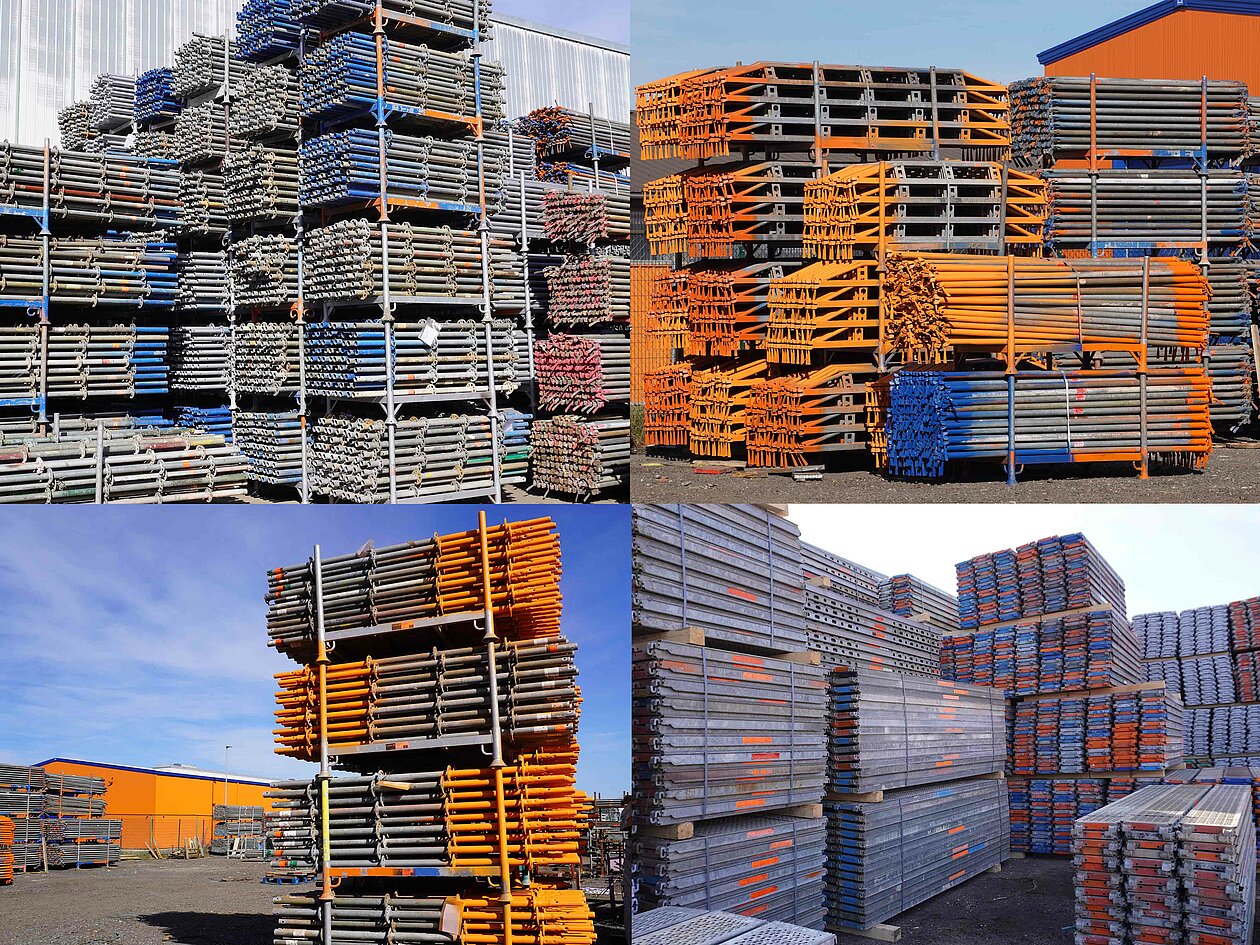
CETRAC stocks over 40,000 inspected scaffolding components at our Leipzig warehouse - from Layher Allround and Hünnebeck Bosta to Peri Up. Used complete scaffolds are available immediately, delivered across Germany within 3-4 days. On request within 24-48 hours, Europe-wide by express.
Three steps to the right scaffold:
- Send your enquiry: state the area, building height and special features (courtyard, bay windows, slopes)
- Receive a quote: CETRAC prepares an individual quote within 24 hours, including a system recommendation
- Delivery or collection: from our Leipzig warehouse or straight to your site
FAQ: Buying scaffolding for old building renovation
For rendering work on old buildings - whether external render, renovation render or ETICS installation - a facade scaffold with bracket extensions is the first choice. The brackets make it possible to bridge projecting cornices, bay windows or sills without repositioning the entire scaffold structure. A deck width of at least 0.60 m, better 0.73 m, is important so that rendering with tools and material is possible at the same time. For very irregular facades, a modular scaffold that can be freely adjusted in bay length is recommended.
Yes - but it comes down to the right system. With courtyard widths under 6 m, a standard facade scaffold with bay lengths of 2.50 - 3.07 m quickly reaches its limits. This is where a modular scaffold delivers the solution: with freely selectable bay lengths from 0.50 m, it can be erected even in very confined situations without permanently blocking escape routes or access ways. CETRAC provides individual advice on request and, where needed, plans a 3D configuration for special situations.
The required scaffold area is building perimeter × building height (in metres), minus areas that don't need work, such as window areas (approx. 20 - 30% on old buildings). As a rule of thumb: a detached apartment building with 4 storeys and a 10 × 12 m footprint has a facade area of approx. 250 - 320 m². For a single-family house in old building stock, 80 - 120 m² is often enough. The CETRAC EasyFlow tool calculates the exact area in just a few steps.
That depends on the project duration and the resale value. If you're only renovating for one season and have no further projects planned, hiring often works out cheaper. But if you're renovating for several weeks or months - which is common on old buildings due to successive trades (plasterer, painter, window fitter) - an inspected used scaffold pays for itself quickly. At CETRAC, complete scaffolds are available from approx. €1,700 for 102 m². Once finished, the scaffold can be sold on or returned via CETRAC - so the residual value is retained.
The load class indicates how much weight per m² of scaffold level may be applied at any one time (standard: DIN EN 12811-1). The following guide values apply to typical old-building renovation work:
- Load class 2 (150 kg/m²): painting, light rendering work, window replacement
- Load class 3 (200 kg/m²): rendering with equipment, facade insulation (ETICS)
- Load class 4 (300 kg/m²): masonry work, heavy material loads
For most old-building renovations, load class 3 is the practical choice. If in doubt, agree the load class with your scaffold supplier or a structural engineer.
Old masonry of solid brick, rubble stone or timber framing bears loads differently from modern reinforced concrete. Before setting scaffold anchors, the masonry should be checked for load-bearing capacity - for historic fabric, approval by a structural engineer is recommended. The most suitable options are expansion anchors or chemical bonded anchors designed specifically for perforated brick or old masonry. Never set anchors into render or stucco elements - always into the load-bearing masonry behind.
Yes, in many cases a permit is required. If the scaffold occupies the public footpath or road space - which is almost always the case for old buildings in inner-city locations - a special-use permit must be applied for at the responsible road traffic authority or local council. Processing takes 1 - 4 weeks depending on the authority. For scaffolds standing entirely on your own property, no separate permit is usually needed - though a building-permit requirement may still exist depending on the federal state.
Yes, inspected used scaffolds are just as safe as new equipment - provided they have been properly inspected. At CETRAC, every part is checked for cracks, deformation and corrosion before sale and complies with German safety standards (DIN EN 12811-1). Important when buying: check the approval numbers and make sure the parts are system-compatible (e.g. all parts of type Layher Allround or all Hünnebeck Bosta - mixed systems without approval are not permitted).
Three systems have proven themselves for old-building renovations:
- Layher Allround: Highly flexible modular scaffold; its variable node spacing adapts well to irregular building geometries. Wide availability of accessories and special parts.
- Hünnebeck Bosta: Classic frame scaffold, ideal for linear facades, fast assembly, robust steel construction.
- Peri Up: Modern system scaffold with ergonomic advantages and a high safety standard thanks to its advance guardrail.
All three systems are available at CETRAC as inspected used scaffolding and as new stock from our warehouse.
| Buy (used, CETRAC) | Hire (market average) | |
|---|---|---|
| 102 m², standard | from approx. €1,744 | approx. €400 - 600/month |
| 204 m², standard | from approx. €3,297 | approx. €800 - 1,200/month |
| 510 m², standard | from approx. €7,859 | approx. €1,800 - 2,800/month |
On a typical old-building renovation of 3 - 6 months the purchase price often matches the total hire cost - with no residual value left over. If you buy, you can sell the scaffold on after the renovation and recover a substantial part of the purchase price. All purchase prices excl. VAT and delivery costs, as of 04/2026.