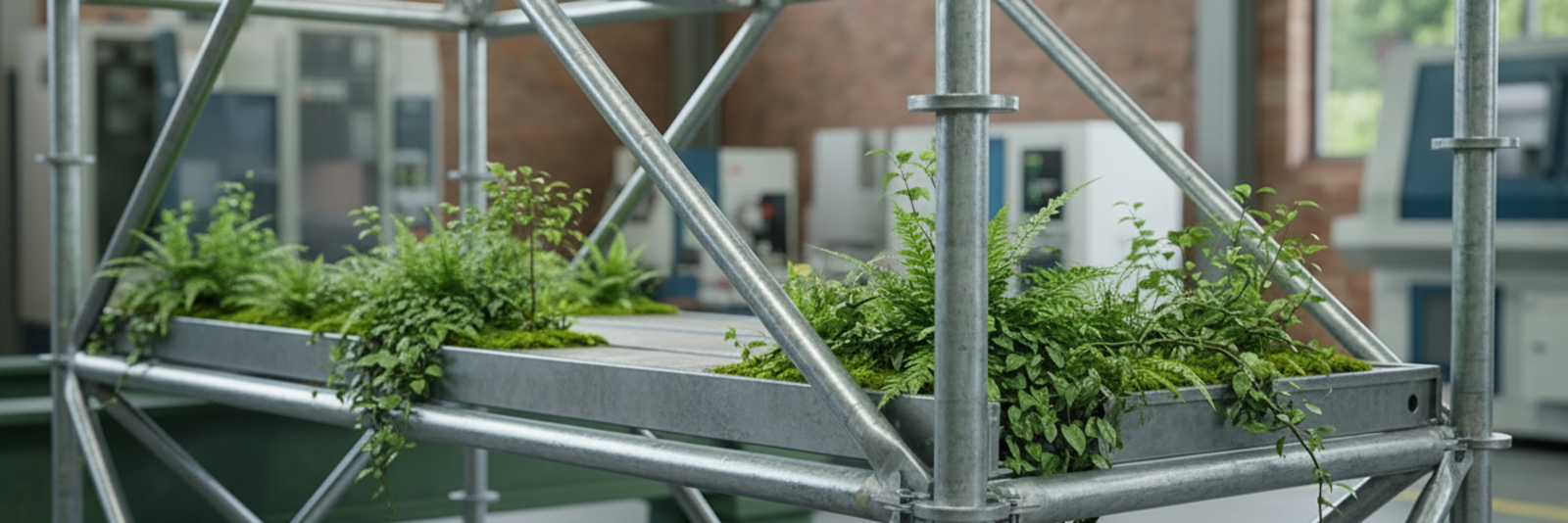
CO₂ savings calculator
Every square metre of reused system scaffolding replaces newly produced steel. Enter your scaffolding area - we calculate the avoided emissions transparently.
Your input
Calculation
| Steel quantity (area × kg/m²) | 9,000 kg |
| CO₂ new steel production (× 1.7) | 15,300 kg |
| less reconditioning, used (5%) | − 765 kg |
| Calculated avoided | 14,535 kg |
How we calculate & comparison
Methodology
Calculation method: Avoided emissions = area × steel/m² × CO₂/kg of steel × (1 − reconditioning deduction). With the default settings: 1 m² ≈ 29 kg CO₂e.
Basic principle (substitution / Module D according to EN 15804): Buying used scaffolding replaces the new production of an equivalent quantity of steel. What is avoided is the manufacturing footprint (cradle-to-gate, A1 - A3) of that new steel.
- Steel per m²: selectable via “Scaffolding system” (16 / 18 / 24 kg/m²; real-world range ~15 - 25).
- CO₂ per kg of steel: ~1.7 kg CO₂e (hot-dip galvanised structural steel, conventional route). Primary route ~2.0 - 2.5; electric steel/scrap ~0.8 (IBU / ArcelorMittal).
- Reconditioning deduction: inspection, transport, light refurbishment of the used material.
- *Car illustration: 118 g CO₂/km (average car).
Adjust assumptions
Comparison
| Scaffolding area | CO₂ emissions avoided |
|---|---|
| 100 m² | ≈ 2.9 t |
| 250 m² | ≈ 7.3 t |
| 500 m² | ≈ 14.5 t |
| 1,000 m² | ≈ 29.1 t |
| 2,500 m² | ≈ 72.7 t |
CO₂e, rounded, facade scaffold standard (~18 kg of steel/m²).
How CETRAC operates sustainably and conserves resources
At CETRAC, sustainability is not a label - it is the business model itself. From its warehouse in Leipzig, CETRAC keeps large quantities of high-quality steel in circulation with over 250,000 immediately available parts on 24,000 m² of warehouse space - supplying over 3,500 customers in 42 countries.
- Reuse instead of new production. Every component traded replaces a newly manufactured one - avoiding its production emissions.
- Inspected quality. Used scaffolding is checked for function, dimensional accuracy and safety before being resold. Used does not mean inferior.
- Extending service life. Steel scaffolding is built to last for decades. CETRAC makes sure it actually reaches that lifespan instead of being scrapped early.
- Availability & supply chains. Used material is available immediately and decouples projects from long lead times and raw-material price swings for new material.
The closed loop: buy-back guarantee
CETRAC not only sells used scaffolding - the company also buys it back. Technically sound scaffolding is taken back for up to five years after the sale at just a 15% difference to the list price. That literally closes the material loop: what is sold today comes back to the warehouse tomorrow and finds another project - instead of being scrapped. This is exactly how a working circular economy in scaffolding looks.
The CO₂ advantage - calculated in concrete terms
The size of the effect can be quantified. Based on transparent assumptions, one square metre of reused scaffolding area avoids around 29 kg of CO₂e. For an average facade scaffold this quickly adds up:
| Scaffolding area | Calculated CO₂ emissions avoided |
|---|---|
| 100 m² | ≈ 2.9 t CO₂e |
| 500 m² | ≈ 14.5 t CO₂e |
| 1,000 m² | ≈ 29 t CO₂e |
| 2,500 m² | ≈ 73 t CO₂e |
Basis: ~18 kg of steel/m² × ~1.7 kg CO₂e per kg of steel, minus 5% for reconditioning. Values are approximations.
Circular economy in construction: from consumption to reuse
The construction industry is responsible for a considerable share of global resource consumption. The way out of this dilemma is the circular economy: keeping materials in circulation for as long as possible instead of disposing of them after a single use.
Used scaffolding is a prime example. It is:
- Durable - usable for decades,
- standardised - manufacturer-compatible and combinable across systems,
- fully reusable - without downcycling, at the same quality level.
The used-scaffolding trade thus contributes directly to sustainability goals such as those increasingly demanded by the EU taxonomy and corporate ESG reports. For construction companies, buying used material becomes a contribution that can also be documented.
Why scaffolding is an underrated sustainability lever
Steel is the backbone of every system scaffold - and one of the most CO₂-intensive building materials of all. Conventional blast-furnace steel production causes around 2.0 to 2.5 tonnes of CO₂ per tonne of steel. This is exactly where the lever lies: every component that gets a second, third or fourth life does not have to be produced again.
A steel scaffold is the ideal candidate. It is robust, standardised, usable for decades and almost completely reusable. While other building materials end up in landfill after one life cycle, a scaffolding component stays in use for generations - provided there is a working market for inspected used material. CETRAC serves that market.
Embodied carbon: the footprint lies in production
Most of a scaffold’s environmental impact arises not during use but during its production (raw materials, smelting, galvanising). This “grey energy” has already been invested once the component exists. Reuse keeps using it instead of spending it a second time. That is the core of the ecological advantage - and it is measurable.
What this means for your construction project
Building sustainably and building economically are not a contradiction - with scaffolding, the two coincide:
- Lower costs than new material with comparable function and safety.
- Available immediately, without lead times for new production.
- Documentable environmental contribution for tenders, ESG reporting and sustainability-minded clients.
- Value retention - inspected system scaffolding keeps its use and resale value for years.
FAQ: sustainable construction with used scaffolding from CETRAC
Yes. Inspected used scaffolding meets the same standard and safety requirements as new material. Steel does not lose load-bearing capacity through reuse; what matters is the inspection and dimensional accuracy of the components.
Based on transparent assumptions, around 29 kg of CO₂e per square metre of scaffolding area, because the energy-intensive production of new steel is avoided. For 500 m², that is about 14.5 tonnes of CO₂e.
Because steel production is highly emission-intensive at around 2 to 2.5 tonnes of CO₂ per tonne. Reuse avoids exactly these production emissions.
Yes. Used scaffolding is cheaper than new material, available immediately and retains its value - the ecological and economic advantages coincide.
It stays in the loop. CETRAC buys back technically sound scaffolding for up to five years after the sale - at just a 15% difference to the list price. Material is reused instead of scrapped.